


In our modern world, it is impossible to avoid every single toxic ingredient, pollutant, or environmental exposure that we may come into contact with. Thankfully, our bodies have built-in support to help get rid of, or “detox”, these toxins from the body. Even so, it’s helpful to try to reduce exposures where we can. We don’t have control over every possible exposure that exists; exposure to car exhaust, for example, while walking through a city, is inevitable. Thankfully, we do have more control over other areas, like the products we use, the supplements we take, and the food we eat. Here, we’ll discuss the possible impact of pesticides on our health and our hair, and ways to mitigate it.
Environmental Exposures & Hair Health: Pesticides
Health & Wellness
5 Min Read

Get hair, health, and science news delivered right to your inbox.
What are pesticides and where do we find them?
Pesticides are chemicals used to help control unwanted organisms, or “pests”, mainly in agricultural settings. The term “pesticides” is often used as a blanket term to include not only pesticides but also herbicides (to control weeds), fungicides (to control fungi/spores), insecticides (to control insects), and more.1
As pesticides are most commonly used in agricultural settings, the negative health impacts of occupational pesticide exposure in settings such as farming, landscaping, and gardening have been well-established in research.2 In addition, there is a growing body of evidence showing negative health outcomes in people who live near or frequently visit golf courses, sports facilities, nurseries, vineyards, and other areas treated with high levels of pesticides.2
Those of us who do not work in these occupations or live near these areas are not fully off the hook, however. Annually, over 1 billion pounds of 500 different pesticides are used in the United States, ending up on ingredients that make their way into food, supplements, and personal care products. Since pesticides can be absorbed through skin, inhaled, or ingested, many of us experience low-dose, ongoing pesticide exposure.1,3 Newer research shows that it’s not just exposure to excessive amounts of pesticides, like living near or working in agricultural settings, but also smaller everyday pesticide exposures that can increase the risk of negative health outcomes.3
How do pesticides impact the body and hair?
There are many studies on pesticide exposure showing an increased risk in the development of multiple disease states.1,4-5 Some ingredients and particles found within pesticides have been shown to trigger an immune response and can also impact hormones, which creates the potential to have negative downstream effects on our hair.1
Environmental exposure can also impact the hair follicles directly through contamination and absorption through the skin and scalp, as well as internal exposure from toxins entering the bloodstream from inhalation or ingestion.1 This results in toxin exposure on the hair from inside and out, which has the potential to cause direct injury to the hair follicles and impact all hair follicle functions.1
And how do we know pesticides are ending up in the hair? Our hair is considered a detox organ. When our body wants to get rid of something, for example, pesticides, it will push them out into the hair as the hair grows. As the hair grows, the toxins effectively leave the body. This is why hair testing is a common way in which environmental exposures like pesticides are evaluated.1,6-7
Pesticide exposure alone may not seem like much of a challenge for your hair or body to detox, but keep in mind that most of us are exposed to multiple environmental factors at once, from pesticides and herbicides to heavy metals, tobacco smoke, and chemicals commonly found in our personal care products.1 Many studies focus on single-exposure concerns, but do not explore how the real-life long-term combination of multiple exposures interacts with each other or within the body.6 Reducing the combination of exposures we are all exposed to, where possible, may support whole-body and hair health.
Reducing exposure to pesticides.
In your workspace: Learning about pesticides used, their common side effects, and protective practices can go a long way in reducing exposure in the workplace.8,9 The highest exposure in a workplace setting commonly occurs through direct contact with pesticides while mixing and spraying, and exposure can be significantly reduced through the use of personal protective equipment (PPE) like protective clothing, chemical-resistant gloves and masks, and proper disposal of pesticide containers.10 Avoiding walking through pesticide spray and regular bathing can also help reduce exposure.10
Where you live: For those who live near farms, vineyards, golf courses, or other high-use pesticide areas, it’s important to keep in mind that pesticides can contaminate the air, soil, and water and travel a fair distance depending on humidity, wind, and other environmental conditions.10,11 Wearing protective clothing, limiting time outdoors during spraying, and bathing after being outside may be helpful to reduce exposure.
In the environment: For those of us not working or living near areas of high pesticide use, we can focus on reducing pesticides through the products we choose to buy. For example, choosing organic food, when possible, can help reduce pesticide exposure and has been shown to produce positive health outcomes.12 The Environmental Working Group (EWG)’s Shopper’s Guide, released every year, uses USDA testing of 47 common fruits and veggies to help shoppers determine the safest (Clean Fifteen™) and least-safe (Dirty Dozen™) foods.13
Choosing supplements with minimal pesticide exposure.
Supplements are made with ingredients that could be exposed to pesticides, and while the FDA regulates dietary supplements, it is up to individual supplement companies to take initiatives with their research, sourcing, and testing to make sure they are manufacturing products that do not contain unsafe amounts of contaminants. Third-party certification can help you make safer choices when choosing supplements.
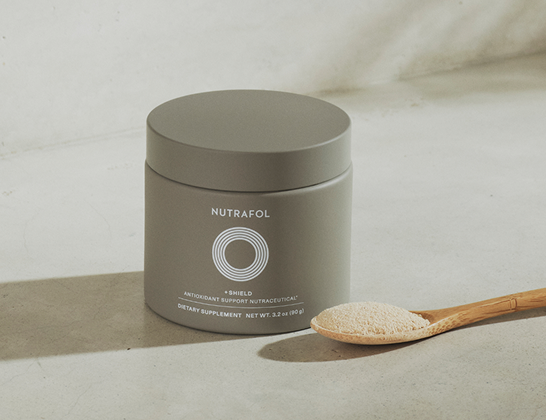
Nutrafol Hair Growth Nutraceuticals are NSF Certified for Sport®, the “gold standard” for supplement quality and safety. The NSF Certified for Sport® label means a supplement has gone through rigorous quality assurance testing, including label claim verification, expert toxicology reviews of every ingredient, and testing for contaminants like heavy metals and pesticides.
Some supplements may also have ingredients with antioxidant activity to support the body's normal metabolic processes. Some ingredients found in Nutrafol Hair Growth Nutraceuticals may provide support, including:
Curcumin: Extracted from turmeric for its antioxidant properties that fight free radicals to support cellular health.14
Tocotrienol Complex: A concentrated form of vitamin E, a super antioxidant that fights against environmental stress to improve hair density.15
Resveratrol: Typically found in red wine, it provides antioxidant activity, promoting hair density by protecting the scalp from environmental damage.16
Pesticides are a common environmental exposure to consider when supporting whole body and hair health. The largest exposure risk tends to be among agricultural workers, but any of us may be exposed to pesticides through secondary air, water, or soil pollution or through the food we eat or products we use. Pesticides are associated with adverse health outcomes, which can impact our whole body, but also impact our hair through negative downstream effects or through direct impact on the hair follicles. Reducing pesticide exposure, such as choosing organic food or supplements with third-party testing, may help to support overall body and hair health, especially in the long-term.

Samra T, et al. The effects of environmental pollutants and exposures on hair follicle pathophysiology. Skin Appendage Disord. 2024;10(4):262–272. doi:10.1159/000537745
de Graaf L, et al. Occupational pesticide exposure, cancer and chronic neurological disorders: a systematic review of epidemiological studies in greenspace workers. Environ Res. 2022;203:111822. doi:10.1016/j.envres.2021.111822
Baudry J, et al. Dietary pesticide exposure and non-communicable diseases and mortality: a systematic review of prospective studies among adults. Environ Health. 2023;22(1):76. doi: 10.1186/s12940-023-01020-8
La Serra L, et al. Measurement of pesticides in hair samples from pemphigus foliaceus and pemphigus vulgaris patients in Southeastern Brazil. An Bras Dermatol. 2023;98(5):644–650. doi:10.1016/j.abd.2022.10.010
Peng FJ, et al. Association of hair polychlorinated biphenyls and multiclass pesticides with obesity, diabetes, hypertension and dyslipidemia in NESCAV study. J Hazard Mater. 2024;461:132637. doi:10.1016/j.jhazmat.2023.132637
Crocoli LC, et al. Pesticides analysis in alternative biological matrices. Drug Chem Toxicol. 2023;46(4):809–824. doi:10.1080/01480545.2022.2090574
Polledri E, et al. Cumulative pesticides exposure of children and their parents living near vineyards by hair analysis. Int J Environ Res Public Health. 2021;18(7):3723. doi:10.3390/ijerph18073723
Ayaz D, et al. The effectiveness of educational interventions aimed at agricultural workers' knowledge, behaviour, and risk perception for reducing the risk of pesticide exposure: a systematic review and meta-analysis. Int Arch Occup Environ Health. 2022;95(6):1167–1178. doi: 10.1007/s00420-022-01838-8
Karimi-Shahanjarini A, et al. Cultural appropriateness in randomized controlled trials aimed at reducing pesticide exposure among farmers and farmworkers: a systematic review. Int Arch Occup Environ Health. 2023;96(1):27–44. doi:10.1007/s00420-022-01880-6
Röösli M, et al. Interventions to reduce pesticide exposure from the agricultural sector in Africa: a workshop report. Int J Environ Res Public Health. 2022;19(15):8973. doi:10.3390/ijerph19158973
Boonupara T, et al. Airborne pesticides from agricultural practices: a critical review of pathways, influencing factors, and human health implications. Toxics. 2023;11(10):858. doi:10.3390/toxics11100858
Jiang B, et al. The effects of organic food on human health: a systematic review and meta-analysis of population-based studies. Nutr Rev. 2024;82(9):1151–1175. doi:10.1093/nutrit/nuad124
Environmental Working Group. Dirty Dozen™: EWG’s 2025 Shopper’s Guide to Pesticides in Produce. Environmental Working Group. Available from: https://www.ewg.org/foodnews/dirty-dozen.php
Jagetia, G. J Clin Immunol. 2007.
Beoy, L. Tropical Life Sci Res. 2010.
Juchaux, F., et al. Int J of Cosmetic Science. 2020.


