Toggle Navigation
open search bar
click to shop

How Men Can Target Flaky Scalps and Oily Hair

By Nutrafol Team2026-09-28

If you’ve been dealing with a problematic scalp—whether oily, flaky, or both—you’re not alone. Many men assume they just need to wash their hair more often, but if you’ve tried that, you’ve probably noticed it doesn’t really fix the problem. That’s because an oily scalp isn’t a hygiene issue; it’s usually a sign of scalp irritation driven by excessive oil production, yeast overgrowth, and skin barrier dysfunction.1 

But achieving a healthy scalp long-term is possible. Understanding what's happening beneath the surface can help you put together an effective, comprehensive approach. By combining targeted scalp care with internal support and lifestyle changes, you can break the cycle and cultivate a healthy, more supported scalp.

What causes a flaky, oily scalp.

An oily scalp is essentially driven by three core factors: excess oil production, overgrowth of Malassezia yeast, and a compromised skin barrier.2 These factors don’t act independently; but rather, feed into each other, creating a vicious cycle that is difficult to break. 

The excess oil on the scalp creates an ideal environment for Malassezia yeast to proliferate and thrive. As this yeast breaks down oil, it releases byproducts, like free fatty acids, that irritate the scalp.2 Recent research has shown these byproducts can be detrimental to the scalp barrier.3 This damage accelerates skin cell turnover, leading to visible flakes, while oil production and breakdown by yeast simultaneously continue, perpetuating the cycle. 

These processes often begin during puberty, when oil production surges, and can persist throughout adulthood in men, even as the reasons why evolve with age.2

How to support a healthy scalp.

The key to supporting an oily scalp is to dive deeper to address the root causes, not just the surface. Because a problematic scalp can be influenced by both internal and external factors, improvement requires a more comprehensive approach.

External support.

Although it may seem counterintuitive, avoid overwashing your hair, which strips your scalp of natural oils and can actually make oiliness worse—especially if you’re using harsh haircare products. When the scalp is stripped of its natural oils, it often responds by producing even more oil to compensate. 

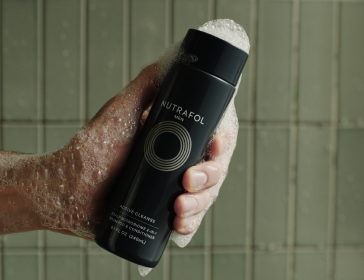
A great option for washing is Nutrafol Men Active Cleanse, a revolutionary 2-in-1 shampoo and conditioner, the first and only to be certified microbiome-friendly,* which is clinically tested to unclog pores, hydrate dry, flaky scalps, and maintain the scalp barrier so that hair can grow and thrive. This formula is physician-formulated for men's unique scalp needs, contains exfoliating enzymes and prebiotics, and dissolves excess oil and build-up for visibly thicker, stronger, fuller hair.4,5

Internal support.

In men, oil glands are highly active, largely due to male hormones (androgens), like testosterone and dihydrotestosterone (DHT), which stimulate oil production at the source.6 Dysfunction in these glands also involves metabolic hormones. Insulin, a hormone that is responsible for blood sugar regulation, and insulin-like growth factor 1 (IGF-1), which helps with blood sugar maintenance, are both influenced by diet and metabolism, and can amplify oil production.6 This means that diets high in refined carbohydrates, sugar, and processed foods may contribute to ongoing scalp issues.7

Diet.

Shifting your diet toward whole, unprocessed foods, incorporating healthy fats like olive oil and fish, and prioritizing fiber-rich carbohydrates like vegetables and legumes can regulate these pathways. The Mediterranean diet, in particular, has been shown to support metabolic health and reduce the body’s response to physical stress, both of which are important for scalp balance.8 Over time, this internal support can help create a healthier foundation for the scalp, rather than simply targeting the surface.

Finding your way to a more supported scalp.

A flaky, oily scalp is a common concern that is not a hygiene issue, but rather can be the result of a complex interplay between oil production, microbial imbalance, hormones, and metabolic health. Because these factors are interconnected, lasting improvement requires more than a quick fix. By supporting the scalp microbiome with targeted care (like Active Cleanse 2-in-1 Shampoo & Conditioner) and addressing internal drivers like diet, stress, and hormonal balance through things like diet changes, you can begin to break the cycle of oil and flakiness, setting the foundation for a healthy scalp—and healthy-looking hair overall. 

FAQs

Why does my scalp get oily so fast?

Oil production on the scalp is primarily driven by androgens like testosterone and DHT, which stimulate the sebaceous glands.6 These glands can be further activated by metabolic hormones like insulin and IGF-1, meaning diet and blood sugar regulation play a role.6 Men with highly active oil glands may notice rapid oiliness, particularly if their diet is high in refined carbohydrates or processed foods.7

Is a flaky scalp the same as dandruff?

Flaking and the scalp condition commonly called dandruff share the same underlying drivers: excess oil production, overgrowth of Malassezia yeast, and a compromised skin barrier.1,2 The yeast breaks down oils on the scalp, releasing byproducts that irritate the skin and accelerate cell turnover, resulting in the visible flakes associated with both.2,3

Can washing my hair more often fix an oily, flaky scalp?

Washing more frequently is a common instinct, but it can actually make things worse. Overwashing strips the scalp of its natural oils, which often triggers the scalp to compensate by producing even more oil. An oily scalp is better addressed by targeting its root causes—excess oil production, yeast overgrowth, and skin barrier dysfunction—rather than by increasing wash frequency alone.1,2

Does diet really affect my scalp?

Yes. Metabolic hormones like insulin and IGF-1 are influenced by diet and can amplify oil production in sebaceous glands.6 Diets high in refined carbohydrates, sugar, and processed foods may contribute to ongoing scalp issues.7 Research suggests that diets supporting metabolic health—such as the Mediterranean diet—can help reduce internal drivers of scalp imbalance.8

How long does it take to see improvement in scalp health?

Scalp health involves interconnected factors—oil production, microbial balance, and skin barrier function—so improvement takes time and consistency. Clinical studies on Nutrafol Men Active Cleanse were conducted over several weeks with men aged 18–65, demonstrating improvements in scalp hydration, pore unclogging, and scalp barrier maintenance with continued use.4,5 Pairing topical care with dietary adjustments may support a more sustained, long-term outcome.

Featured Products

*The first and only 2-in-1 shampoo and conditioner to be certified microbiome-friendly by MyMicrobiome.

References: 

  1. Naldi, L, Rebora, A. Seborrheic dermatitis. N Engl J Med. 2009 Jan 22;360(4): 387-396. doi: 10.1056/NEJMcp0806464.

  2. Ro, BI, Dawson, TL. The role of sebaceous gland activity and scalp microfloral metabolism in the etiology of seborrheic dermatitis and dandruff. J Investig Dermatol Symp Proc. 2005;10:194-197. Available at: https://www.jidsponline.org/action/showPdf?pii=S0022-202X%2815%2952586-4 

  3. Jourdain R, et al. Malassezia restricta-mediated Lipoperoxidation: a novel trigger in dandruff. Acta Derm Venereol. 2023 Feb 15:103:adv00868. doi: 10.2340/actadv.v103.4808.

  4. Based on a clinical study with a total of 35 men aged 18-60. 

  5. Based on a clinical study with a total of 26 men aged 18-65. 

  6. Li J, et al. Endocrine and metabolic drivers of sebum dysregulation: Mechanisms and therapeutic strategies. Life Sci. 2025 Dec 15:383:124044. doi: 10.1016/j.lfs.2025.124044.

  7. Tripathy K, et al. Insulin resistance, metabolic syndrome, and inflammatory skin disease. J Clin Me. 2026 Jan 1;15(1):330. doi: 10.3390/jcm15010330.

  8. Mechanick J, et al. Cardiometabolic-based chronic disease, addressing knowledge and clinical practice gaps: JACC state-of-the-art review. J Am Coll Cardiol. 2020 Feb 11;75(5):539-555. doi: 10.1016/j.jacc.2019.11.046.

share with emailshare with Facebookshare with Twittershare with Pinterestshare with LinkedIn

Sign up for the Nutrafol Newsletter

© 2026 Nutraceutical Wellness Inc. All Rights Reserved.

These statements have not been evaluated by the Food and Drug Administration. This product is not intended to diagnose, treat, cure or prevent any disease.