


Winter can be beautiful, but for our hair, it’s often the most challenging time of year. Cold air, indoor heating, and cozy hats might keep us warm, but they can leave hair dehydrated, damaged, and frizzy. Understanding the science behind these environmental changes helps us better support our hair health and keep frizz under control all season long.
The Science of Frizz in the Winter
Tips & Tricks
5 Min Read

Get hair, health, and science news delivered right to your inbox.
Why winter is a perfect storm for frizz.
Changes in the air.
Healthy hair depends on moisture balance. When the air gets cold, its ability to hold water vapor decreases dramatically, which makes it drier.1 That dry air pulls moisture from the surface of the hair, leaving strands parched and prone to frizz. Indoor heat adds another layer of dryness, further stripping hair of hydration.
When hair loses moisture, the friction between dry hair strands produces static, causing individual hairs to repel one another and create stubborn flyaways.2 Over time, the combination of dryness, static, and daily wear and tear leads to microscopic changes that weaken and roughen the cuticle, further contributing to tangling and frizz.3
Fabrics.
When choosing winter hats and scarves that touch your hair, consider two things:
Fiber type, which influences static.
Surface texture, which influences friction.
Synthetic fibers like polyester tend to build more static than natural fibers, and textured fabrics create more friction than smooth weaves.4-6
Most hair-friendly:
Silk: Natural fiber (low static) + very smooth weave (minimal friction) → lowest frizz.
Good alternatives:
Cotton sateen: Natural fiber (low static) + smooth weave (low friction) → low frizz.
Polyester or nylon satin: Synthetic fiber (more static) + very smooth weave (low friction) → low frizz
Less ideal:
Textured cotton: Natural fiber (low static) + textured weave (high friction) → frizz.
Textured synthetic fabrics (cable knits, velvet, fleece, many wool blends): Synthetic fibers (high static) + textured weave (high friction) → highest frizz risk.
The bottom line: For fabrics that sit directly against your hair, smoother is better. When choosing a hat, opt for one lined with a smooth material. Silk is the gold standard, with other smooth weaves as very reasonable alternatives.
Diet.
Diet changes during the holidays also play a role. Higher intake of sugar, simple carbs, and alcohol can disrupt the balance of nutrients that support healthy hair growth and moisture retention.7–11 Diets high in sugar can lead to resistance to insulin, which in turn can negatively impact hair health.10,11
How frizz impacts hair, according to type.
Porosity.
Not all hair reacts to winter the same way. A key factor is porosity, or how well hair absorbs and retains moisture. Hair porosity depends largely on the outermost layer of the strand, the cuticle, which is made of overlapping keratin scales, much like roof shingles, which vary across hair types.12
Straight hair tends to have a flatter cuticle that provides better moisture retention. Curly, coily, or damaged hair has a more lifted cuticle layer.3 That means high-porosity hair, whether naturally curly or chemically processed, loses moisture more easily and becomes frizzy more rapidly in dry winter air.
Structure.
Curly and coily hair types face another challenge: their structure. Because of the twists and turns of the hair shaft, natural scalp oils can’t easily travel from root to tip, leaving ends dry and less protected from moisture loss. Even if sebum production at the scalp is normal or high, the lack of even distribution makes curly/coily hair more prone to dryness and frizz.3
When moisture enters and exits hair repeatedly, such as with humid-to-dry winter transitions, it can cause “hygral fatigue,” or repeated swelling and drying of the strands. Over time, this weakens the cuticle, increasing breakage and frizz.3 Understanding your hair’s porosity and structure can help you choose the right protective steps for the season.
How to beat winter frizz.
Caring for strands.
Since the only living, active part of hair is the hair follicle, hair strands can’t repair themselves once damaged. Topical care and gentle habits can go a long way in visibly restoring smoothness and reducing breakage.
High-quality conditioners can help protect hair during the winter. They work by temporarily filling in tiny fractures in the cuticle and coating the strand, thus regulating moisture retention, smoothing the cuticle’s surface, and minimizing friction.13 Protein-based conditioners with amino acids or hydrolyzed proteins can also penetrate the strands to strengthen and fortify them more deeply.3,13
Equally important is minimizing friction and mechanical stress. Avoid harsh chemical treatments, aggressive brushing, and over-washing, all of which can strip or weaken the cuticle.3
Taking an internal approach.
Finally, nourish your hair from within. Balance winter comfort foods with options rich in protein, healthy fats, and vitamins. High-quality protein, such as meat, poultry, dairy, beans, nuts, and seeds, provides the amino acids cysteine and methionine, which are needed for keratin synthesis.10 Omega-3 fatty acids from fish, flaxseed, and walnuts help maintain the lipid layer that seals in moisture.10 Foods rich in B Vitamins, like leafy greens, beans, and whole grains, along with vitamin A (beta-carotene) from foods like carrots and sweet potatoes, support balanced oil production, protecting hair against fragility and frizz.10
Physician-formulated support.
Nutrafol Hair Growth Nutraceuticals provide targeted support for stronger hair from within, offering ingredients that balance oil, support healthy hair and hydration, and can help support against the stressors of the winter environment.
For external support, Nutrafol’s Strand Defender Conditioner is a lightweight, physician-formulated conditioner with glucose fibers and vegan protein to strengthen and defend hair against damage. It’s clinically tested to replenish moisture and improve elasticity, helping hair stay smooth and strong.14
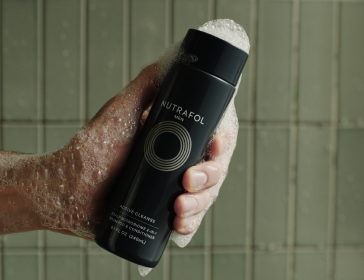
Active Cleanse 2-in-1 Shampoo & Conditioner for men is physician-formulated for the bio-specific needs of men’s scalps, replenishing hydration and detangling without weighing hair down. It’s designed to strengthen and improve the visible health and quality of the hair.15,16
Strand Serum is a physician-formulated, bi-phase leave-in treatment built around a patent-pending DualFusion™ Complex, combining an oil phase (including Hemisqualane and Rosehip Fruit Extract) with a water phase (including Milk Thistle Seed Extract and Wild Olive Extract) to work at the cuticle and cortex at the same time. For hair that’s high-porosity, damaged, or chemically treated—the strands most vulnerable to winter’s dry, static-prone air—it’s clinically tested to reduce breakage by 83% over time, reduce split ends by 62%, and help protect hair from heat styling up to 450°F.†
Protecting hair in the winter.
Winter frizz isn’t a flaw in your hair—it’s simply a response to the environment during this time of year. Thankfully, you can take steps to reduce the impact on air, temperature, friction, and diet on your hair. An inside-and-out approach to hair care in the winter can go a long way in helping keep your locks smooth and resilient all winter long.


†Strand Serum is clinically tested to reduce breakage by 83% after 5 uses on damp and dry hair vs. non-conditioning shampoo. Strand Serum is clinically tested to cut split ends by 62% after using on damp and dry hair. Strand Serum is clinically tested to protect hair from heat styling up to 450 degrees after using on damp and dry hair.
1. NASA. Air & Water | Understanding Climate. Ocean Surface Topography from Space. Published 2024. https://sealevel.jpl.nasa.gov/ocean-observation/understanding-climate/air-and-water/
2. Sinclair RD. Healthy hair: what is it? J Invest Dermatol Symp Proc. 2007;12(2):2–5. doi:10.1038/sj.jidsymp.5650046
3. Gavazzoni Dias MF. Hair cosmetics: an overview. Int J Trichology. 2015;7(1):2–15. doi:10.4103/0974-7753.153450 https://pmc.ncbi.nlm.nih.gov/articles/PMC4387693/
4. Cilveli, Gülçin & Okur, Ayse & Sular, Vildan. (2020). Electrostatic Properties of Clothing Fabrics Suitable for Different End-Uses. Fibres and Textiles in Eastern Europe. 28. 50-57. 10.5604/01.3001.0013.5858. https://www.researchgate.net/publication/339594301_Electrostatic_Properties_of_Clothing_Fabrics_Suitable_for_Different_End-Uses
5. Al-Osaimy AS, Mohamed MK, Ali WY. FRICTION COEFFICIENT AND ELECTRIC STATIC CHARGE OF HEAD SCARF TEXTILES. J Egyptian Soc Tribol. 2012;9(3):24–39. Accessed 2025 Oct 24. https://jest.journals.ekb.eg/article_80884_b857981e5f85aabac6b359a4faea0544.pdf
6. Kang DX. The Fabric Factor: The Role of Your Pillowcase and Hair Accessories in Hair Care. TRI Princeton. Published 2023 Dec 4. Accessed 2025 Oct 24. https://www.triprinceton.org/post/the-fabric-factor-the-role-of-your-pillowcase-and-hair-accessories-in-hair-care
7. Guo EL, Katta R. Diet and hair loss: effects of nutrient deficiency and supplement use. Dermatol Pract Concept. 2017;7(1):1–10. Published 2017 Jan 31. doi:10.5826/dpc.0701a01 https://pmc.ncbi.nlm.nih.gov/articles/PMC5315033/
8. Trüeb RM. "Let Food be Thy Medicine": Value of Nutritional Treatment for Hair Loss. Int J Trichology. 2021;13(6):1–3. doi:10.4103/ijt.ijt_124_20 https://pmc.ncbi.nlm.nih.gov/articles/PMC8647708/
9. Lim S, Shin J, Cho Y, Kim KP. Dietary Patterns Associated with Sebum Content, Skin Hydration and pH, and Their Sex-Dependent Differences in Healthy Korean Adults. Nutrients. 2019;11(3):619. Published 2019 Mar 14. doi:10.3390/nu11030619 https://pmc.ncbi.nlm.nih.gov/articles/PMC6471406/
10. Goluch-Koniuszy ZS. Nutrition of women with hair loss problem during the period of menopause. Prz Menopauzalny. 2016;15(1):56–61. doi:10.5114/pm.2016.58776 https://pmc.ncbi.nlm.nih.gov/articles/PMC4828511/
11. Shi X, Tuan H, Na X, et al. The Association between Sugar-Sweetened Beverages and Male Pattern Hair Loss in Young Men. Nutrients. 2023;15(1):214. Published 2023 Jan 1. doi:10.3390/nu15010214 https://pmc.ncbi.nlm.nih.gov/articles/PMC9824121/
12. Rees M. Hair: Types and care instructions. Medical News Today. Published 2021 July 2. https://www.medicalnewstoday.com/articles/hair-types
13. Fernandes C, Medronho B, Alves L, Rasteiro MG. On Hair Care Physicochemistry: From Structure and Degradation to Novel Biobased Conditioning Agents. Polymers (Basel). 2023;15(3):608. Published 2023 Jan 24. doi:10.3390/polym15030608 https://pmc.ncbi.nlm.nih.gov/articles/PMC9921463/
14. Based on a clinical study with a total of 36 women aged 18-60.
15. Based on a clinical study with a total of 35 men aged 18-60.
16. Based on a clinical study with a total of 26 men aged 18-65.


