


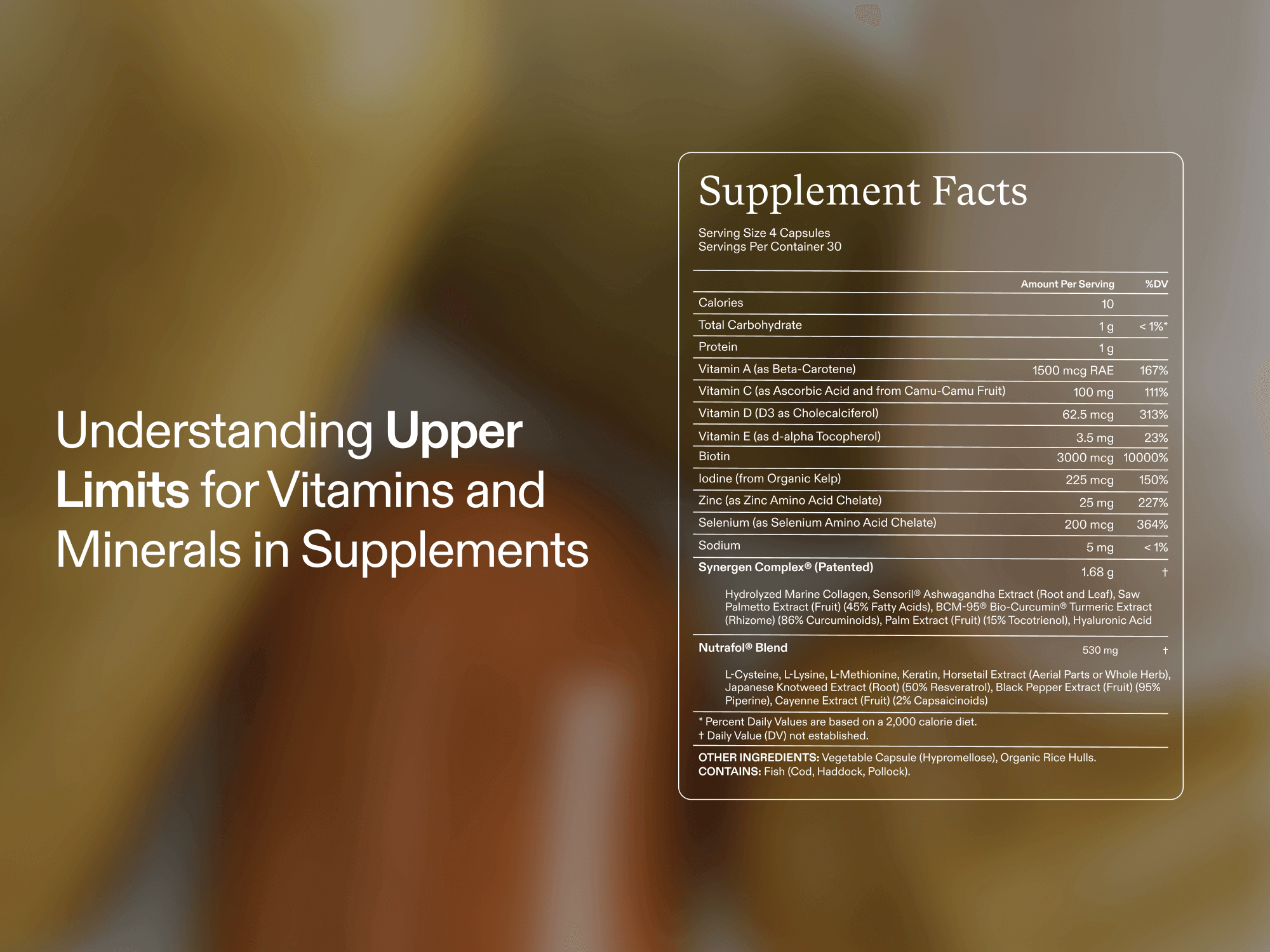
Whether you’re starting a new supplement regimen or just want to make informed choices, understanding supplement labels is key. But reading them isn’t always as straightforward as it seems.
US regulation requires that dietary supplement labels include the amount per serving and the % Daily Value or %DV (if established) for each nutrient, which shows how much one serving contributes toward the recommended daily intake of that nutrient (NIH).
What you won’t usually see on a label is the Tolerable Upper Intake Level (UL), also referred to as the Upper Limit. The UL is the highest level of a nutrient that is unlikely to cause adverse health effects in most people in the general population.
In other words: The %DV is the starting point to aim for each day, while the UL is a guidepost showing the upper end of the safe range (NCBI).
For most nutrients, there’s a big gap between the %DV and the UL, which means you have plenty of flexibility to meet your needs without exceeding them. But if you take more than one supplement, or any that are non-third-party certified, it helps to check that you’re comfortably within the range.
The takeaway: Aim to stay between the %DV and the UL unless otherwise discussed with your healthcare provider, and always talk with your healthcare provider before starting or combining supplements, especially if you have health conditions.


