Toggle Navigation
open search bar
click to shop

Three Studies, One With a Placebo Group: How Nutrafol Men Was Actually Tested.

By Nutrafol Team2026-11-26

When you’re told a supplement is “backed by clinical studies," it’s a good start, but it’s not the full story. To actually understand the quality of evidence, you’ll need to know how those studies were set up, what they found, and (crucially) how they found it. 

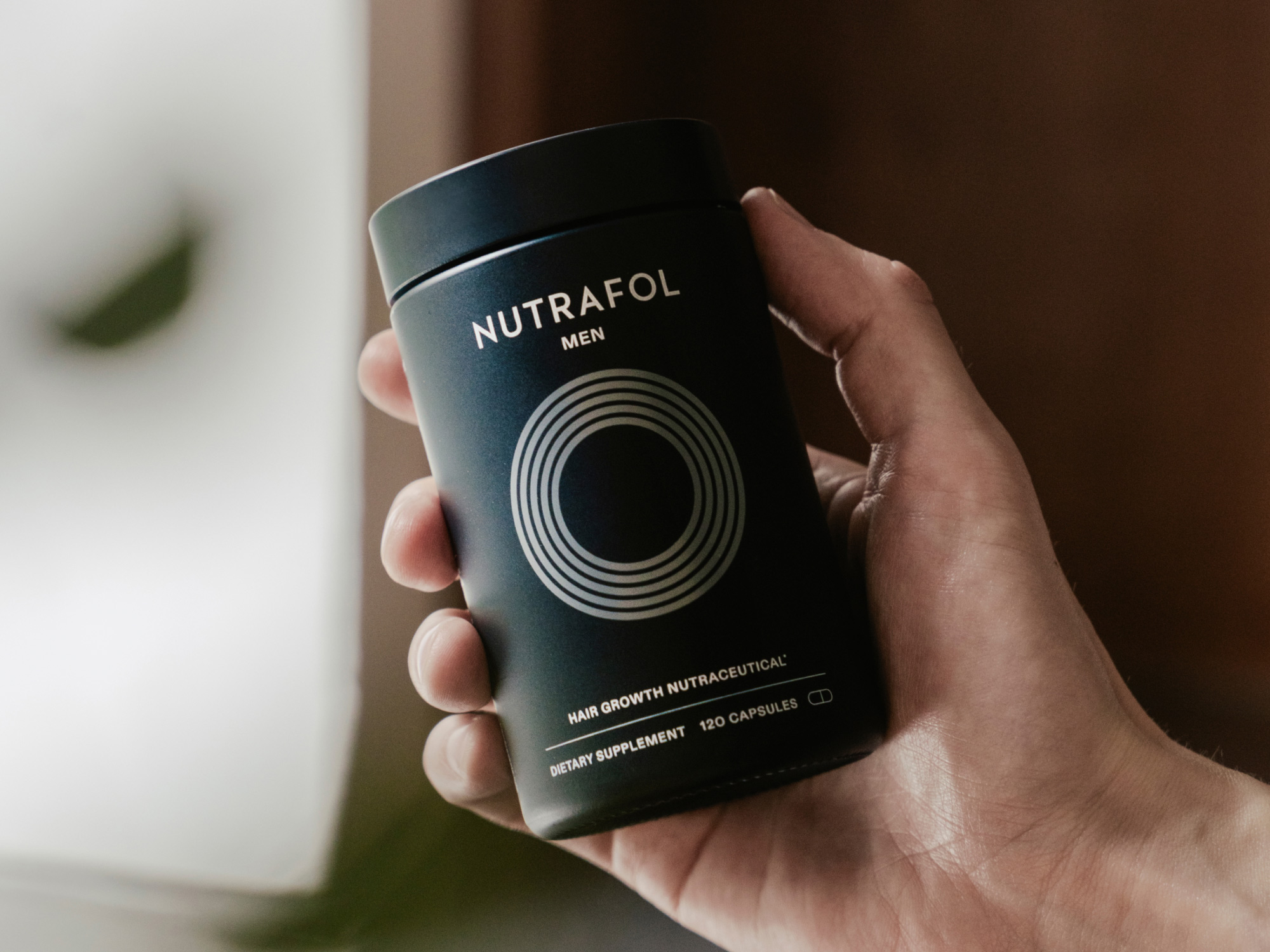
Nutrafol Men's clinical support spans five studies in total. Here, we're focusing on three, each designed to shed light on a different piece of how Nutrafol Men performs.* One is a randomized, placebo-controlled trial that tested Nutrafol Men directly against a placebo over six months. Another looked at whether that same effect held up across a range of races and ethnicities. And a third actually measured the hair itself with an instrument.

*The remaining two serve another purpose: One is a set of case reports, and one is a marketing study built around a self-perception questionnaire and photos; they're left out here because of their format, not their results.

Study One: The Randomized, Placebo-Controlled Trial

The strongest evidence behind Nutrafol Men comes from a randomized, double-blind, placebo-controlled trial1 published in the Journal of Cosmetic Dermatology. This study design is considered the gold standard in clinical research because it's built specifically to separate a product's real effect from everything else that can move a result: natural fluctuation, extra attention to a routine, or simply time passing.2

A total of 112 men enrolled, ages 21 to 61, and 85 completed the 6-month trial: 52 on Nutrafol Men, 33 on placebo. Neither the men nor the investigators knew who was on which. At day 180, significantly more men in the active group improved than in the placebo group, by blinded investigator assessment, for both hair growth (79% versus 51%) and hair quality (74% versus 54%). A validated men's hair growth questionnaire† agreed, showing that men in the active group reported better improvements in hair growth than the placebo group. The trial also looked at sexual function using a validated scale and found no trend of change in either group.

A result like this tells you the effect is real. The next question is whether it holds up beyond the group tested here, and across different hair types, races, and ethnicities.

†A quick note on validated questionnaires: These questionnaires have been tested and shown to accurately assess user-perceived changes in scalp hair during clinical trials for men’s hair.3 This differs quite a bit from a marketing or self-perception questionnaire that was created for a particular study of a particular product.

Study Two: Confirming the Results Across Races and Ethnicities

To answer that question, a separate peer-reviewed study looked specifically at whether results held up across different racial and ethnic groups,4 published in the Journal of Clinical and Aesthetic Dermatology. It included both men and women taking their respective Nutrafol Hair Growth Nutraceutical formulas.

Another step in solidifying clinical support for Nutrafol Men was to check that it worked across a diverse population. That's because hair varies by race and ethnicity: straight and curly hair can differ in follicle shape, density, and growth rate. On top of that, certain patterns of hair thinning tend to show up more frequently in some ethnic groups and races than in others.4 Therefore, the study's subjects represented four different racial and ethnic groups: Asian, Black/African American, Hispanic/Latino Caucasian, and Non-Hispanic/Latino Caucasian.

What the study found: Investigator ratings of overall growth, coverage, density, and volume were significantly improved at weeks 12 and 24, with improvement seen in 83% of male participants by week 24. The racial and ethnic comparisons combined men and women using their respective Nutrafol Hair Growth Nutraceutical formulas; within that combined analysis, results held up consistently across all four groups studied.

A trained investigator scoring standardized photographs is a meaningfully higher bar than a self-reported survey. This study doesn't have its own placebo group, owing to the fact that it would be impractical to include a separate placebo for every subgroup tested here. But that's not its job here: the placebo-controlled trial above establishes that the effect is real. This study's role is showing that the effect generalizes across a range of hair types and backgrounds.

A Third Kind of Evidence: Measuring the Hair Itself

A third study added objective, instrumental measurement to hair strands’ physical properties. Hair strand thickness was simply measured before taking Nutrafol Men and then after. In a 6-month study using a microscope and calipers to measure hair fiber diameter directly, men using Nutrafol Men experienced a significant 7% increase after 180 days.5 Investigator assessment also showed significant improvement in hair strength, growth, and fullness over the course of the study. 

Why does a thicker strand matter? Separate biomechanical research on human hair has found that fibers with a greater diameter tend to resist breakage and offer more scalp coverage, translating to more volume and strength overall.6 That lines up with what this study assessed: Alongside the increase in fiber diameter, investigators also rated significant improvement in all measured hair parameters, including strength, growth, and fullness—in other words, longer, stronger hair.

The Recap

  • Nutrafol Men's claims rest on three studies that do different jobs: a randomized, double-blind, placebo-controlled trial establishing that the product outperforms placebo; a study showing that result holds up across a range of races and ethnicities; and a third study using an instrument to measure hair fiber diameter directly.

  • The placebo-controlled trial1 found significantly more improvement in the active group than placebo, by blinded investigator assessment, with no reported change in sexual function in either group.

  • The multi-ethnic study4 found significant improvement, by investigator rating, in 83% of participants at week 24, with consistent results across all four racial and ethnic groups studied.

  • A third study measured hair diameter directly and found a significant 7% increase at day 180.5

References

  1. Bhatia N, Ablon G, Hazan A, Raymond I. A randomized, double-blind, placebo-controlled study to evaluate the safety and efficacy of a nutraceutical supplement with standardized botanicals in males with thinning hair. J Cosmet Dermatol. 2025;24(1):e16778. doi:10.1111/jocd.16778

  2. Lange S, Sauerland S, Lauterberg J, Windeler J. The range and scientific value of randomized trials. Dtsch Arztebl Int. 2017;114(38):635-640. doi:10.3238/arztebl.2017.0635

  3. Thadanipon K, Suchonwanit P. Measuring patient quality of life following treatment for alopecia. Patient Prefer Adherence. 2021;15:1601-1610. doi:10.2147/PPA.S282399

  4. Stephens TJ, Berkowitz SR, Marshall T, Kogan S, Raymond I. A prospective six-month single-blind study evaluating changes in hair growth and quality using a nutraceutical supplement in men and women of diverse ethnicities. J Clin Aesthet Dermatol. 2022;15(1):21-26. PMID: 35309272

  5. Draelos Z, Farris PK, Hazan A, Raymond I. A 6-month, prospective, multi-arm study for the efficacy of standardized nutraceuticals to improve hair fiber thickness and strength. Dermatol Ther (Heidelb). 2026;16:353-363. doi:10.1007/s13555-025-01582-0

  6. Erik B, Havitcioglu H, Aktan S, Karakus N. Biomechanical properties of human hair with different parameters. Skin Res Technol. 2008;14(2):147-151. doi:10.1111/j.1600-0846.2007.00268.x

share with emailshare with Facebookshare with Twittershare with Pinterestshare with LinkedIn

Sign up for the Nutrafol Newsletter

© 2026 Nutraceutical Wellness Inc. All Rights Reserved.

These statements have not been evaluated by the Food and Drug Administration. This product is not intended to diagnose, treat, cure or prevent any disease.