Toggle Navigation
open search bar
click to shop

A 12-Month Study of Nutrafol Women's Balance, Half of It Against a Placebo.

By Nutrafol Team2026-11-04

Key takeaways

  • The clinical study behind Nutrafol Women's Balance ran 12 months. The first 6 months were a randomized, double-blind, placebo-controlled trial. The second 6 were an open-label extension, where everyone, including the women originally on placebo, took the real supplement.

  • In the placebo-controlled phase, women taking Women's Balance had significant increases in hair counts and significantly better investigator-assessed hair growth and quality than the placebo group, plus a 32% reduction in shedding, by day 180.1

  • When the original placebo group switched to the real supplement for the extension, they showed the same pattern the active group had shown months earlier: significant increases in hair counts, less shedding, and better investigator assessments of growth and quality.2

  • For those on Nutrafol Women’s Balance for the full 12 months, hair growth and quality improved progressively. Terminal hair count rose 13.4% and total hair count rose 11.7% from baseline, both statistically significant. Participants also reported improvements in quality of life affected by hair and menopausal symptoms over the course of the study.2

  • The supplement was well tolerated, with no reported adverse events across the full 12 months.2 

  • Both phases were peer-reviewed and published in the Journal of Drugs in Dermatology.

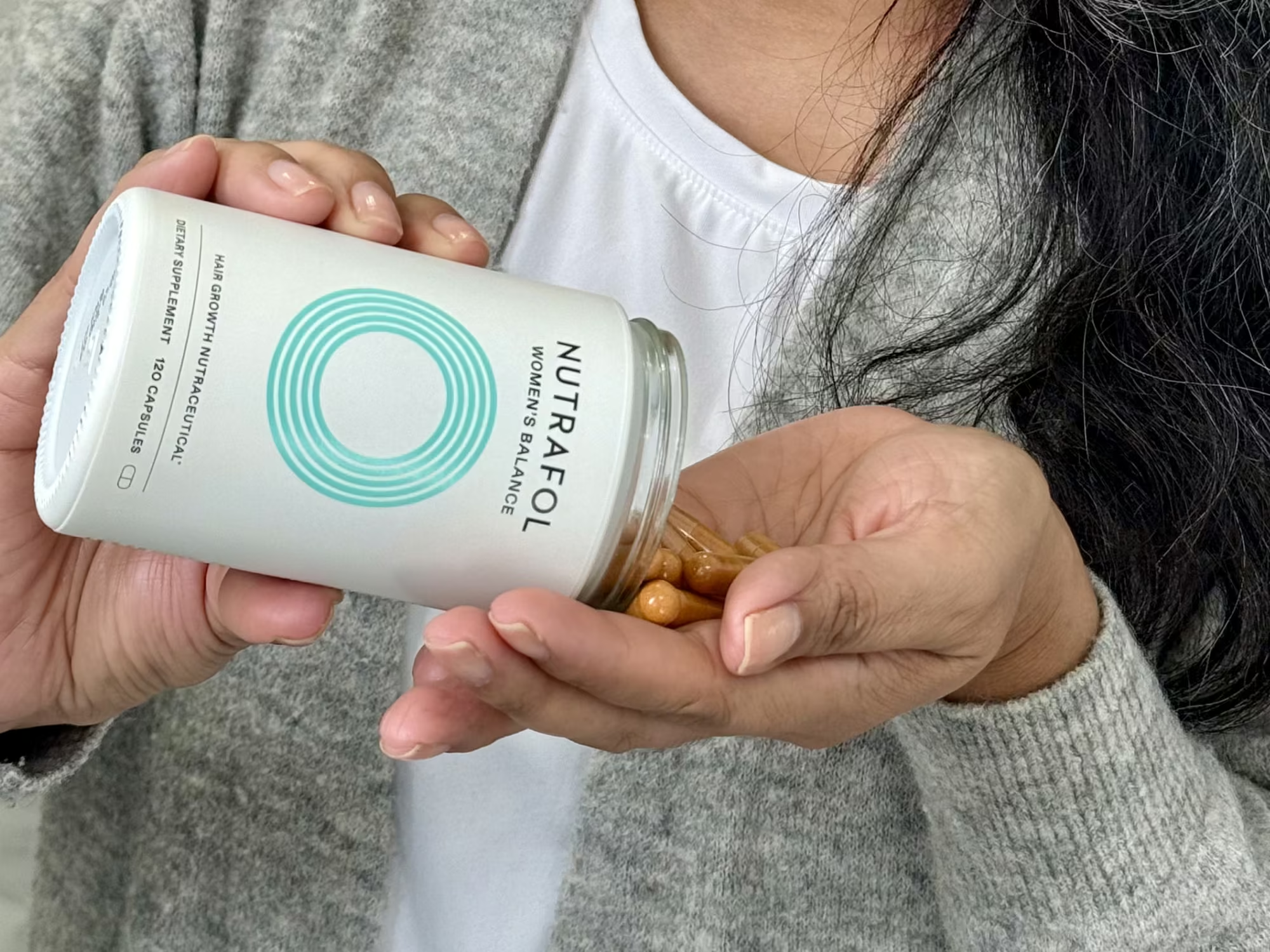
If you're weighing whether a hair supplement actually does anything, or whether hair just changes on its own timeline during perimenopause and menopause, that's a fair question, and it's exactly what a placebo group is built to answer. Nutrafol Women's Balance was tested in a 12-month clinical study with a rigorous design: the first six months were randomized and placebo-controlled, the following six months were open-label. Here's what the study measured, what it found in each phase, and why the second half matters as much as the first.

What the placebo comparison was designed to show

Hair growth is slow and variable, so it's genuinely hard to know if a change is coming from a product versus from time, hormonal fluctuation, or simply paying more attention to your hair.3 A randomized, double-blind, placebo-controlled design is how researchers isolate the answer: Some participants get the real product, some get an inert look-alike, neither the participants nor the investigators know who got which, and any difference between the two groups is attributed to the product itself rather than to chance. 

That's the design behind this study. Seventy women ages 40 to 65, all perimenopausal, menopausal, or postmenopausal with self-perceived thinning hair, were randomly assigned to Nutrafol Women's Balance (40 women) or a placebo (30 women) for 6 months. Investigators tracked terminal, vellus, and total hair counts using macrophotography of a marked area of the scalp, counted shed hairs from a standardized wash test, and had a blinded investigator score global hair growth and quality on a 7-point scale at day 90 and day 180.1

A quick sidebar on the hair types mentioned above: Terminal hairs are the thicker, longer, pigmented hairs that make up visible scalp coverage; vellus hairs are the short, fine, often colorless hairs—tracking both is how researchers catch early gains, not just the more visible terminal ones.4

The first 6 months: results measured against placebo

By day 180, the group taking Women's Balance showed a significant, progressive increase in terminal and total hair counts compared to placebo, and vellus hair counts increased significantly in the active group while decreasing in the placebo group. Hair shedding dropped by 32% in the active group relative to baseline, and the blinded investigator's growth and quality scores improved significantly more in the active group than in the placebo group. The supplement was well tolerated. This phase was peer-reviewed and published on its own in the Journal of Drugs in Dermatology, and it's the piece of this research that answers the "would this have happened anyway" question directly.1

The next 6 months: no more placebo, and a built-in second look

At month 6, every participant moved into an open-label extension and started taking the real supplement, including the 30 women who had been on placebo. That handoff created a kind of natural follow-up experiment: The same women who'd shown no meaningful change while on placebo were now taking the actual formula, and researchers could watch whether their results tracked with starting the product itself.2

They did. Once the former placebo group switched to Women's Balance, they had significant increases across all hair counts and a significant decrease in shedding—the same pattern the original active group had already shown. That's a second signal pointing to the same conclusion as the first 6 months: The change tracked with the product, not with the passage of time.2

Across the full 12 months, women who'd been on Women's Balance from the start continued to improve. Terminal hair count rose from a mean of 68.1 at day 0 to 77.2 at day 360, a 13.4% increase. Total hair count rose from 78.4 to 87.58, an 11.7% increase. Both changes were statistically significant, and both moved in the same progressive direction across time rather than plateauing. Participants also reported improvements in quality of life affected by hair and menopausal symptoms through a validated questionnaire at the end of the study, and the supplement remained well tolerated.2

It's worth being direct about one limitation: Because everyone was on the active supplement by month 7, the second half of this study doesn't have its own placebo comparison, and subjects knew what product they were taking. Open-label extensions are standard for tracking longer-term safety and continued effect, but the placebo-controlled first phase is what carries the strongest evidence on its own.2

What this means

Two separate groups of women, tested months apart, both showed the same result once they were actually taking Nutrafol Women's Balance: better hair counts and less shedding. That's what makes this study more than a single before-and-after story. This is why Nutrafol Women's Balance is clinically proven to improve hair growth and hair quality, and it's part of a broader research program that includes Nutrafol's 28 clinical studies.

Featured Products

References

  1. Ablon G, Kogan S. A randomized, double-blind, placebo-controlled study of a nutraceutical supplement for promoting hair growth in perimenopausal, menopausal, and postmenopausal women with thinning hair. J Drugs Dermatol. 2021;20(1):55-61. PMID: 33400421

  2. Ablon G, Kogan S, Raymond I. A long-term study of the safety and efficacy of a nutraceutical supplement for promoting hair growth in perimenopausal, menopausal, and postmenopausal women. J Drugs Dermatol. 2022;21(7):776-783. doi:10.36849/JDD.6912

  3. Natarelli N, Gahoonia N, Sivamani RK. Integrative and mechanistic approach to the hair growth cycle and hair loss. J Clin Med. 2023;12(3):893. doi:10.3390/jcm12030893

  4. Grymowicz M, Rudnicka E, Podfigurna A, et al. Hormonal effects on hair follicles. Int J Mol Sci. 2020;21(15):5342. doi:10.3390/ijms21155342

share with emailshare with Facebookshare with Twittershare with Pinterestshare with LinkedIn

Sign up for the Nutrafol Newsletter

© 2026 Nutraceutical Wellness Inc. All Rights Reserved.

These statements have not been evaluated by the Food and Drug Administration. This product is not intended to diagnose, treat, cure or prevent any disease.